
Launching a crypto-powered sweepstakes casino requires careful planning, technology selection, development, testing, and deployment. For businesses considering crypto sweepstakes casino software, one of the first questions is often: How long will development take?
There is no single timeline that applies to every project. A basic platform using ready-made components may be launched considerably faster than a fully customized enterprise solution. The development timeline depends on the platform's features, integrations, customization requirements, security architecture, game library, payment systems, and testing requirements.
For most businesses, a well-planned project can take several weeks to several months, depending on the complexity of the platform.
Typical Development Timeline
A crypto sweepstakes casino software project can generally be divided into several stages:
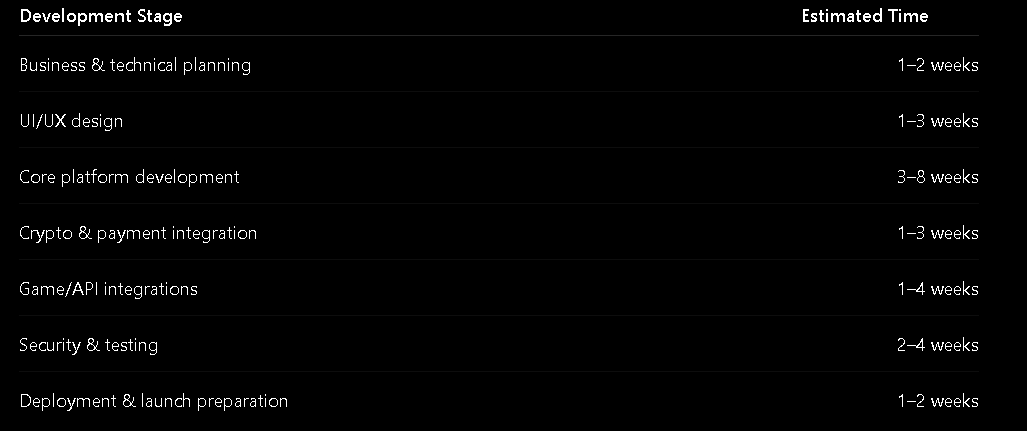
These stages can overlap, so the total project timeline isn't necessarily the sum of every stage. A turnkey solution can also shorten the timeline considerably because many core components are already available.
1. Business and Technical Planning
The first stage involves defining exactly what the platform needs to accomplish.
Businesses and development teams typically establish:
Target audience
Platform business model
Game categories
Payment requirements
Cryptocurrency support
Player management requirements
CRM integrations
Security requirements
Admin functionality
Scalability goals
This stage may take one to two weeks, depending on project complexity.
Good planning helps prevent scope changes later in development.
2. UI/UX Design
The next stage focuses on creating the platform's user experience.
Designers may develop:
Homepage
Registration screens
Player dashboard
Game lobby
Wallet interface
Promotions section
Account management
Mobile layouts
For an enterprise platform, the design process may take several weeks because different user journeys and administrative interfaces need to be considered.
3. Core Platform Development
This is typically one of the most time-consuming stages.
Developers build the platform's primary functionality, including:
Player registration
Login and authentication
Player profiles
Wallet management
Game lobby
Bonus and reward systems
Admin dashboard
Reporting
Notifications
The complexity of these components directly affects the overall timeline.
A platform built with existing modules can move faster, while a completely customized solution may require considerably more development time.
4. Crypto and Payment Integration
Crypto functionality adds another important development layer.
Depending on the business requirements, the platform may need integration with:
Cryptocurrency wallets
Payment gateways
Blockchain networks
Transaction monitoring systems
Currency conversion services
Developers must ensure transactions are handled securely and accurately.
The number of supported cryptocurrencies and payment methods can significantly influence development time.
5. Game and API Integrations
A modern crypto sweepstakes casino software platform typically requires access to a diverse game library.
Instead of developing every game internally, operators can integrate third-party game providers through APIs.
Integration work can include:
Game provider APIs
Game launch systems
Player session synchronization
Game data
Wallet connectivity
Transaction handling
The number and complexity of integrations will affect the timeline.
6. Security Implementation
Security should be incorporated throughout development rather than added at the end.
Important areas can include:
Secure authentication
Data encryption
Wallet security
Access controls
Fraud monitoring
Transaction protection
Account security
Crypto-related platforms require particular attention to transaction and wallet security.
7. Testing and Quality Assurance
Before launch, the platform should undergo extensive testing.
QA teams may test:
User registration
Login functionality
Game launches
Wallet transactions
Payment processing
Mobile responsiveness
API integrations
Platform performance
Security vulnerabilities
Testing can take two to four weeks or longer, depending on the platform's size.
A thorough QA process helps identify technical issues before they affect users.
8. Deployment and Launch
After testing, the platform can be prepared for production.
Launch preparation may include:
Server configuration
Domain setup
Database configuration
Monitoring
Final security checks
Production deployment
Administrative training
Once everything is verified, the platform can be made available to users.
What Can Speed Up Development?
Businesses can shorten development timelines by using a well-established technology foundation.
A turnkey solution can provide pre-built components such as:
Player management
Admin dashboards
Game integrations
Wallet functionality
CRM connectivity
Analytics
This reduces the amount of functionality that needs to be developed from scratch.
Clear requirements also help prevent delays caused by repeated changes during development.
What Can Increase the Timeline?
Several factors can extend the development schedule.
Extensive Customization
A highly customized interface, wallet system, loyalty program, or business workflow requires additional development.
Multiple Integrations
Integrating numerous payment providers, blockchain networks, game providers, and third-party systems increases technical complexity.
Advanced Security Requirements
Enterprise-level security testing and fraud prevention systems can require additional development and testing.
Regulatory Requirements
Businesses must consider the legal and regulatory requirements applicable to their intended markets. These requirements can influence platform architecture, player verification, payment processes, and operational workflows.
Frequent Scope Changes
Adding major features after development has started can affect both cost and delivery time.
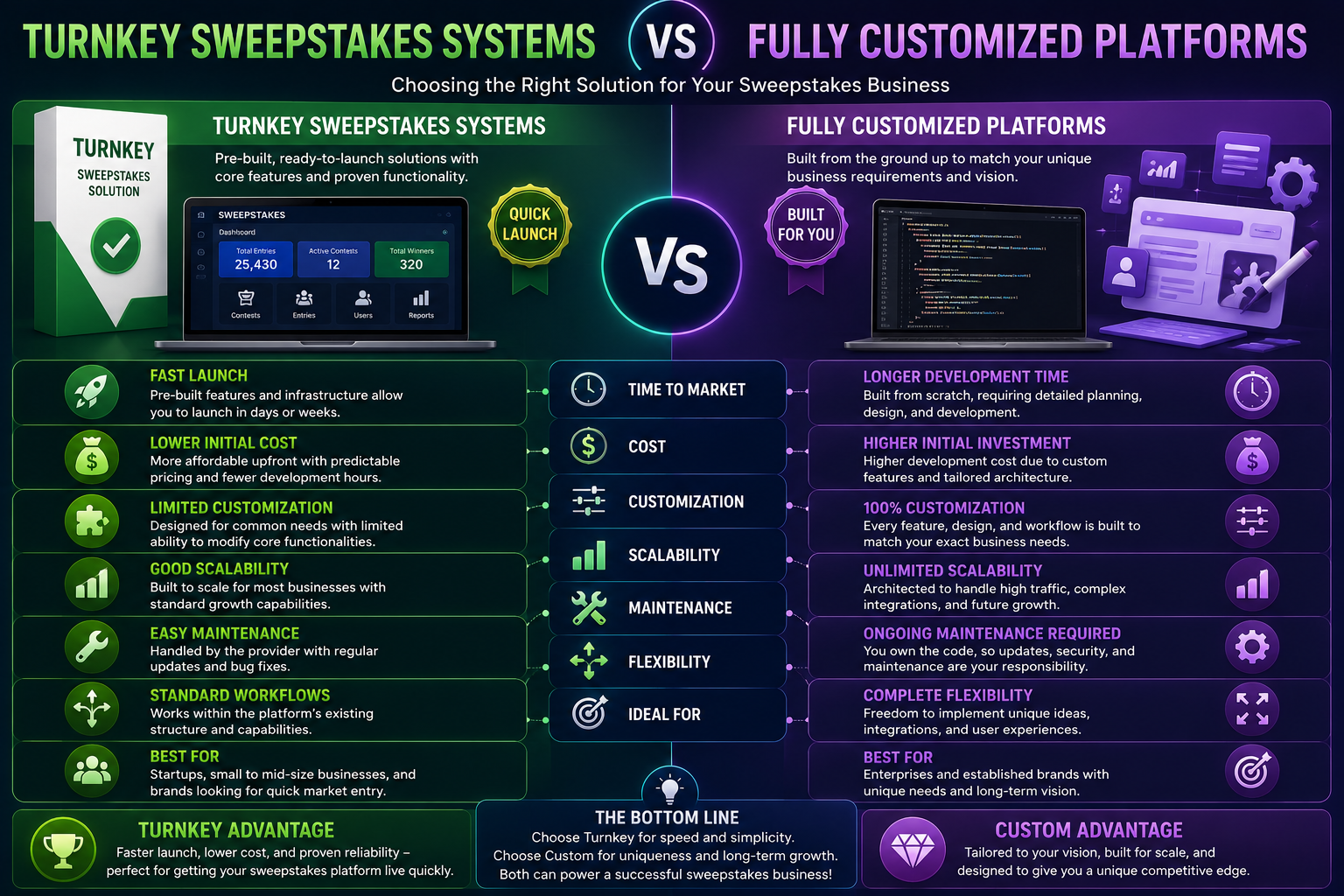
Turnkey vs Custom Development Timeline
The development approach can make a significant difference.
Turnkey crypto sweepstakes casino software generally offers a faster route to market because core functionality is already developed.
Custom development provides greater control over functionality and user experience but typically requires more time.
Businesses should therefore select an approach based on their priorities. If speed is the primary objective, a turnkey solution may be appropriate. If differentiation and highly specific functionality are more important, custom development may be worth the additional investment.
How to Keep the Project on Schedule
Businesses can improve development efficiency by:
Defining requirements before development begins.
Prioritizing essential features.
Selecting reliable APIs and integrations.
Using scalable architecture.
Conducting testing throughout development.
Establishing clear communication with the development team.
Avoiding unnecessary scope changes.
Planning security and compliance requirements early.
A structured development process helps minimize unexpected delays.
Conclusion
The development timeline for crypto sweepstakes casino software depends on the platform's complexity, customization requirements, integrations, security standards, and business objectives. A straightforward turnkey solution can potentially be launched much faster than a fully customized enterprise platform, while complex projects may require several months of development and testing.
Businesses should focus not only on how quickly a platform can be launched but also on whether the technology can support long-term growth, security, performance, and operational requirements.
TIGSweepstakes helps businesses develop scalable sweepstakes casino solutions with modern platform architecture, flexible integrations, player management capabilities, and technology designed to support evolving business needs. By combining a structured development process with the right technology foundation, TIGSweepstakes helps operators move from planning to launch more efficiently while building a platform prepared for future expansion.







Write a comment ...